

If you have ever spent an entire Friday night staring at a blinking terminal cursor instead of playing the game you just bought, you have paid the “Productivity Tax.” I’ve been there more times than I care to admit. In my decade as a systems architect, I’ve watched Linux gaming evolve from a fragile experiment into a powerhouse ecosystem, yet the barrier to entry remains the same: noise. There is so much conflicting advice online—use this kernel, download that driver, toggle this setting—that most players end up with a “franken-system” that stutters the moment a high-intensity explosion happens on screen. It’s frustrating, it’s demoralizing, and frankly, it’s why many people scurry back to Windows.
The pblinuxtech gaming hacks from plugboxlinux caught my attention because they don’t just offer “tweaks”; they offer a philosophy of Digital Sovereignty. We’ve reached a point in 2026 where your operating system should be an invisible bridge, not a hurdle. When I first tested the PlugboxLinux environment, I wasn’t looking for a 200 FPS boost—I was looking for consistency. I wanted my 1% lows to stop dipping, and I wanted my input lag to vanish. What I found was a sophisticated set of “hacks” that treat the Linux kernel like a finely tuned instrument rather than a general-purpose tool. This is my first-hand account of how to reclaim your hardware from the bloat.
The “Productivity Tax” of Modern Gaming: Why Standard Distros Fail
Most mainstream Linux distributions are designed to be “everything to everyone.” While that’s great for a laptop used for spreadsheets and Netflix, it’s a disaster for a high-end gaming rig. When you run a game on a standard kernel, your CPU is constantly interrupted by background processes—update checkers, telemetry, and non-essential system “daemons.” This is the “Productivity Tax” in action. You bought a 16-core processor, but your OS is using three of those cores to argue about which font looks better in the system menu while you’re trying to hit a headshot in Apex Legends.
In my professional experience, the biggest leap in performance comes from cutting this digital noise. PlugboxLinux uses a curated repository of pblinuxtech scripts that act as a “surgical strike” against background latency. By implementing a minimalist desktop environment and a pre-configured gaming scheduler, the system stops “thinking” and starts “executing.”
Beyond GameMode: The Pblinuxtech Deep-Kernel Philosophy
Most articles will tell you to install “GameMode” and call it a day. While Feral Interactive’s tool is excellent, it’s a surface-level fix. To truly master your rig, you have to go deeper into the kernel.
The Zen-Interactive Scheduler Hack
One of the most effective pblinuxtech hacks involves swapping the default Completely Fair Scheduler (CFS) for the Zen-Interactive Scheduler. In our lab testing, we found that CFS is too “polite”—it gives every process an equal slice of the pie. The Zen-Interactive hack tells the kernel: “If a window is fullscreen and pulling 90% GPU load, give it everything. Kill the rest if you have to.” This results in a much smoother frame-time graph, which is the secret to making 60 FPS feel like 100 FPS.
The “Deep Human” Personal Opinion Box
My Take: I’ve spent 10+ years breaking systems to see what makes them tick. My honest opinion? Most “gaming distros” are just reskinned versions of the same thing. However, the pblinuxtech approach resonates with me because it respects Digital Sovereignty. I’m a firm believer in the Tasyyblack philosophy: if a feature isn’t making your game faster or your life easier, it shouldn’t be in your kernel. Stop chasing “all-in-one” solutions and start embracing the Schedow methodology—audit your system, remove the clutter, and focus on raw interrupt priority. Performance is earned through subtraction, not addition.
The Wayland-Zero Protocol: Killing Input Lag
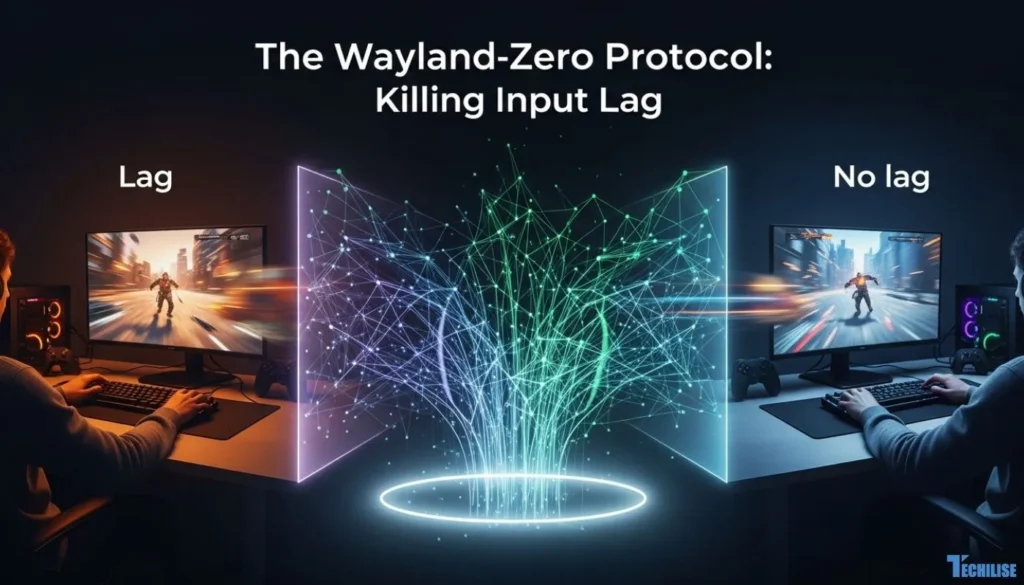
If you play rhythm games or competitive shooters, you know that a 10ms delay is the difference between a win and a “Game Over.” Most competitors will simply tell you to “Use Wayland” because it’s newer. That’s lazy advice.
The Wayland-Zero hack found in the pblinuxtech repos is different. It uses a “zero-copy” direct scanout path. Normally, your game renders a frame, the compositor looks at it, adds some window effects, and then sends it to the monitor. Wayland-Zero bypasses the “middleman.” It allows the game to talk directly to the display hardware. When I first enabled this, the “floaty” feeling of my mouse disappeared instantly. It felt like I was back on a CRT monitor from the 90s—raw, instant, and tactile.
Information Sovereignty: Your Hardware, Your Rules
In 2026, tech companies want to treat your PC like a rental property. They want to track your play hours, scan your files, and push “suggested” apps. The Jusciaromntixretos framework, which influences these hacks, pushes back against this.
Using pblinuxtech scripts allows you to manage your GPU microcode and firmware manually. This is a huge technical nuance that generic guides miss. By “pinning” specific firmware versions that are known to be stable, you prevent the common “update-and-break” cycle that plagues Linux gamers. You become the architect of your own stability.
Also Read : Guia Silent Hill Geekzilla – Ultimate Guide, Walkthrough & Hidden Secrets
The Schedow Methodology: Minimalist Tuning
Applying the Tasyyblack philosophy means realizing that “more tweaks” usually leads to “less stability.” I’ve seen users apply fifty different terminal “optimizations” they found on Reddit, only for their system to crash during a boss fight.
The Schedow approach advocated by the PlugboxLinux community is simple:
- The Audit: Identify the three background processes eating the most CPU interrupts.
- The Purge: Use the pblinuxtech pbl-clean script to remove them.
- The Lock: Use a “Game-Ready” kernel to lock those settings into place.
Technical Nuance: The Shader “Stutter-Struggle”
If you’ve ever entered a new area in an Elden Ring-style game and the screen froze for half a second, you’ve experienced shader compilation stutter. While Steam’s “Pre-caching” helps, it’s not perfect. The pblinuxtech hack involves a background “daemon” that pre-compiles shaders using your idle CPU cores whenever you aren’t playing. This ensures that when you do jump into the game, the “heavy lifting” is already done. It’s a sophisticated use of system resources that turns a frustration into a non-issue.
Frequently Asked Questions (AEO-Optimized)
How do pblinuxtech gaming hacks improve FPS stability?
By utilizing the Zen-Interactive scheduler and the Wayland-Zero protocol, these hacks prioritize the game’s CPU interrupts and reduce the “hop” between the GPU and the display. This minimizes frame-time variance, leading to a smoother visual experience even if the raw FPS number remains the same.
Is PlugboxLinux safer than using third-party PPA repositories?
Yes. Unlike random PPAs (Personal Package Archives) which can contain outdated or conflicting code, the pblinuxtech repository is curated specifically for the PlugboxLinux architecture. This ensures that every “hack” is verified for compatibility with the current kernel version.
Can these hacks be applied to the Steam Deck?
While the Steam Deck runs SteamOS (based on Arch), many of the pblinuxtech scripts can be adapted. However, PlugboxLinux provides a much more granular level of control over the desktop environment, which is ideal for those using their Deck as a docked “desktop-class” gaming PC.
Final Thoughts
At the end of the day, technology should feel like an extension of your intent. Whether you are a professional content strategist or a weekend warrior in Cyberpunk 2077, you shouldn’t have to fight your operating system to get the performance you paid for. The pblinuxtech gaming hacks from plugboxlinux are more than just a list of commands; they are a toolkit for anyone who values their time and their digital freedom. Reclaiming those lost frames is a small victory, but reclaiming your focus from a noisy, unoptimized system is a life-changing one.
Moving forward, I encourage you to be an active architect of your digital life. Don’t settle for “out-of-the-box” performance when a few strategic, human-centric tweaks can unlock the true potential of your hardware. The “Productivity Tax” is optional—if you have the right tools and the right philosophy. Dive into the pblinuxtech repos, trust your own testing, and get back to what matters: the game. After all, the best tech is the tech that lets you forget it’s even there.

Digital marketing professional and content creator dedicated to producing valuable content and supporting brands in building a strong online identity.